Theses
From image processing and robotics through plasma diagnostics to DNA microarray fabrication and characterization: these projects connect experimental physics, automated systems and data analysis.
1996 · Image processing & robotics
In my 1996 mechanical engineering diploma thesis at Coburg University of Applied Sciences, I explored the use of a machine vision system in robotic assembly. The assembly task used the three-dimensional wooden puzzle Teufelsknoten (a burr puzzle), whose interlocking pieces form a spatial structure.
The puzzle brings together several challenges in automation: parts must be identified, correctly aligned and assembled in a suitable sequence. Its interlocking geometry illustrates why assembly involves more than moving to a set of individual positions.
For a person, the connection between seeing a part and moving a hand appropriately is usually intuitive. An automated system needs an explicit processing chain: relevant features must first be identified in the image, then translated into information that relates to the robot’s workspace. Only then can that information be used in a suitable grasping or assembly sequence.
The Teufelsknoten illustrates how closely perception and motion planning are connected. Each part needs to be available at the right time and in the correct orientation. Parts already assembled also restrict the space available for subsequent movements. The wooden puzzle offers a tangible example of how part geometry, assembly order and accessibility interact during assembly.
Machine vision connects visual sensing with mechanical action. Information obtained from camera images can be used to determine the position and orientation of parts and adapt the robot’s movements accordingly. My thesis brought together mechanics, visual sensing, software and robot control through a concrete assembly task.
What makes this subject particularly interesting is that visual recognition becomes practically useful through its connection to a mechanical sequence. The puzzle makes that connection immediately understandable.
Watch the Teufelsknoten video ↗
2001 · Plasma diagnostics
My physics diploma thesis at the University of Bayreuth and the Max Planck Institute for Plasma Physics in Garching investigated how to improve measurements at the edge of a hot fusion plasma. Its title is „Optimierung der ASDEX Upgrade Lithiumstrahl-Diagnostik“.
At the plasma edge, temperature and particle density vary sharply over short distances. Transport processes in this region influence how well the plasma confines energy. Studying them requires measurements with fine spatial and temporal resolution that disturb the plasma as little as possible.
The technique is called Lithium Beam Emission Spectroscopy, or Li-BES. It is an active diagnostic: a deliberately injected beam makes processes in the plasma measurable. In magnetic fusion devices such as tokamaks and stellarators, it can resolve edge electron density profiles and density fluctuations in space and time. Relevant regions include the scrape-off layer (SOL), where magnetic field lines are open, and the pedestal, with its steep density gradients. These regions matter for particle and heat transport. My thesis focused on the lithium beam diagnostic at the ASDEX Upgrade tokamak.
A beam of fast lithium atoms acts as a probe: collisions with plasma particles produce light that can be used to calculate the electron density at the plasma edge. One focus was the optimization of the lithium-ion emitters used to generate the beam. I investigated different emitter designs and glass-ceramic coatings to improve ion emission.
The hot emitters release positively charged lithium ions, which electric fields accelerate and focus. The ions are then neutralized in sodium vapour so that the atomic beam can enter the magnetically confined plasma. The useful particle flux is determined by how many atoms actually reach the narrow observation region. In the high-temperature range studied, a coating with spodumene composition produced roughly twice the ion current of the previously used eucryptite material.
Using ion-optics simulations in SIMION, I also investigated how electric fields and the source geometry affect beam focusing. Comparison with experimental measurements revealed limitations of the simulation method at high space-charge densities. A thermographic method made the beam profile visible through the local heating of a glass-ceramic plate, allowing the actual focusing performance to be assessed.
Space charge means that the positive ions repel one another and modify the source’s electric field. This effect matters for an intense beam. A ring-shaped emitter geometry that initially looked promising in simulation did not deliver the predicted improvement experimentally. Increasing the beam energy from 35 to 60 kiloelectronvolts did improve focusing: the measured full width at half maximum decreased from 13.3 to 7.4 millimetres.
Another focus was fast analysis using neural networks. They learned to translate light profiles into density profiles in less than a millisecond per profile. This makes information about the state of the plasma edge available quickly enough to support control of the experiment.
Training paired experimentally supported density profiles with calculated light profiles and added artificial noise. Two network types were compared, showing different strengths for clean and noisy signals. An additional check was designed to detect inputs outside the range covered by training examples. The work therefore examined accuracy and the limits of the analysis as well as its speed.
Such feedback control would be the next step: a newly recorded light profile would be immediately converted into a density profile that could serve as an input to the experiment’s control system. Alongside computation time, this requires reliable data acquisition and handling of disturbances and unreliable inputs. The thesis establishes important foundations for this and contributes a step towards controlling the plasma.
2008 · DNA-Microarrays
For my PhD at the University of Bayreuth’s Department of Physics, I developed an automated DNA chip fabrication system. A micromirror array directs light onto selected surface areas, where up to 25,000 different short DNA sequences are built step by step.
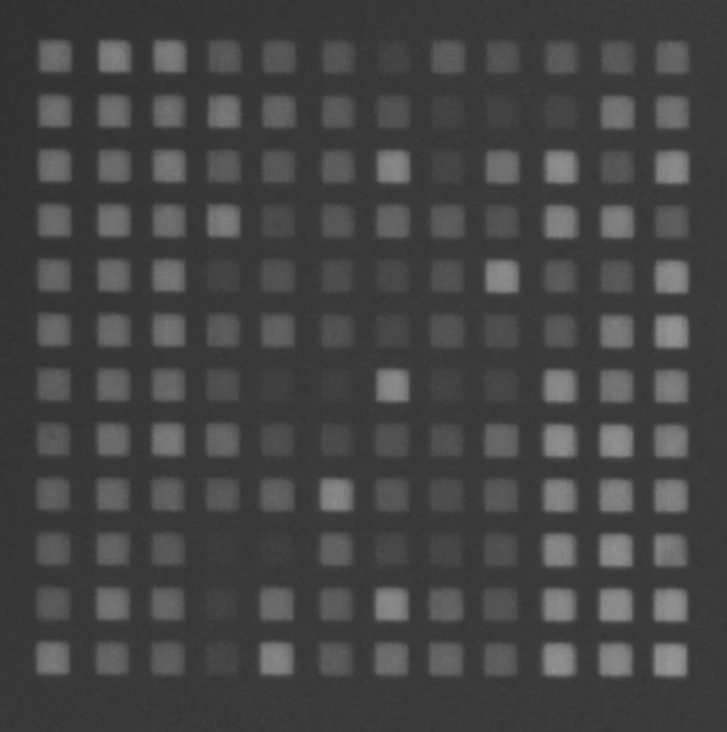
DNA microarray background on Wikipedia ↗
Exposure patterns are generated on a computer and projected onto the surface at reduced scale through microscope optics. Light determines where the next DNA building block can attach, allowing many chosen sequences to be fabricated in parallel. Sharp imaging and low stray light help keep neighbouring areas separate and limit errors.
I used these chips to study how DNA and RNA strands bind to matching partners. A single mismatched or extra base changes binding strength; its position also matters. A molecular zipper model helped explain this effect, informing our understanding and design of these molecular detection systems.
The short DNA strands attached to the surface act as probes. How reliably they distinguish similar sequences depends on the type and location of a defect. The zipper picture describes how the connection between two strands can open or close in sections, helping explain binding differences that a simple comparison of letter sequences misses.
What does a single-base change do on a DNA chip?
A DNA microarray carries many short DNA strands as probes. A matching strand from the sample binds through complementary base pairing. I studied how this binding responds to small changes in sequence:
- Base substitution / SNP: If the probe matches the original sequence, a substituted base can introduce a mismatch. SNP refers to a single-base variant found within a population.
- Deletion: A missing base can leave an unpaired base in the opposite strand.
- Insertion: An extra base can form a small bulge in the duplex.
These defects often weaken binding. In my experiments, their position was particularly important: a defect near the centre usually had a greater effect than one near an end. The affected bases and their neighbours also matter. Some insertions beside identical bases remained comparatively stable. There is therefore no fixed ranking in which a SNP, deletion or insertion always has the largest effect.
The fluorescence signal indicates how much labelled target is bound to a probe. Alongside affinity, it depends on concentration, temperature and experimental conditions. These studies help select probes that distinguish similar sequences more reliably.
Experiments on mismatches, insertions and deletions ↗ · Position dependence and the zipper model ↗
Characterization of Oligonucleotide Microarray Hybridization: Microarray Fabrication by Light-Directed in situ Synthesis – Development of an Automated DNA Microarray Synthesizer, Characterization of Single Base Mismatch Discrimination and the Position-Dependent Influence of Point Defects on Oligonucleotide Duplex Binding Affinities.
Thesis in the university repository ↗
Publications & preprints
Bibliographic titles retain their original language. Journal articles and their associated preprints are both included.
T. Naiser, T. Mai, W. Michel, and A. Ott. Versatile maskless microscope projection photolithography system and its application in light-directed fabrication of DNA microarrays. Review of Scientific Instruments, 77(6):063711, 2006
Open publication ↗W. Michel, T. Mai, T. Naiser, and A. Ott. Optical study of DNA surface Hybridization reveals DNA surface density as a key parameter for microarray hybridization kinetics. Biophysical Journal, 92(3):999-1004, February 2007
Open publication ↗T. Naiser, O. Ehler, J. Kayser, T. Mai, W. Michel and A. Ott. Impact of point-mutations on the hybridization affinity of surface-bound DNA/DNA and RNA/DNA oligonucleotide-duplexes: comparison of single base mismatches and base bulges. BMC Biotechnology 2008, 8:48
Open publication ↗T. Naiser, T. Mai, W. Michel and A. Ott. A versatile maskless microscope projection photolithography system and its application in light-directed fabrication of DNA microarrays. arXiv:q-bio/0608038
Open publication ↗T. Naiser, O. Ehler, T. Mai, W. Michel and A. Ott. Hybridization to Surface-bound Oligonucleotide Probes: Influence of Point Defects. arXiv:q-bio/0612043v1
Open publication ↗T. Naiser, J. Kayser, T. Mai, W. Michel and A. Ott. Point defects and the stability of surface bound oligonucleotide duplexes – experiments and model. BMC Bioinformatics 2008, 9:509
Open publication ↗T. Naiser, J. Kayser, T. Mai, W. Michel and A. Ott. DNA hybridization to surface bound probes: point defects in experiment and model. Phys. Rev. Lett. 102, 218301 May 2009
Open publication ↗
Talks & posters
Talk and poster titles also retain their original language.
Recent Progress in the Lithium-Beam Diagnostic for Tokamak Edge Plasmas. T. Naiser, Hans-Werner Müller und Elisabeth Wolfrum für die EURATOM Assoziation-Kollaboration, DPG Frühjahrstagung, Berlin 2001
Einsatz neuronaler Netze bei Plasmaexperimenten. G. Pautasso, C. Tichmann, E. Wolfrum and T. Naiser. Kolloquium, Universität Rostock 2001
Improved Edge Density Profile Measurements by the Li-Beam Diagnostic on ASDEX Upgrade. H.W. Müller, E. Wolfrum, R. Drube, J.C. Fuchs, A. Kallenbach, B. Kurzan, T. Naiser, J. Neuhauser, J. Schweinzer, ASDEX Upgrade Team. 28th EPS Conference on Controlled Fusion and Plasma Physics Funchal, 18-22 June 2001. European Physical Society, ECA Vol. 25A: 421-424.
Open contribution ↗DNA Chips, Talk at Euroschool-PhysBio2, Non-equilibrium in Physics and Biology, Peyresq, September 2002
DNA Chips and DNA Microarrays - Tools to Watch the Genome at Work. Talk at the Biological Physics group-seminar at MPIPKS, Dresden, November 2004
In situ Synthesis of DNA Chips. T. Naiser, Timo Mai, Wolfgang Michel, and Albrecht Ott. DPG-Frühjahrstagung, Berlin 2005
Kinetics of Solid-Phase DNA Hybridization. Timo Mai, T. Naiser, Wolfgang Michel, Philipp Baske, and Albrecht Ott. DPG-Frühjahrstagung, Berlin 2005
Light-directed in situ Synthesis of DNA Chips and Hybridization Experiments. Talk at Albert Libchabers group seminar, Rockefeller University, New York, March 2006
Light-directed synthesis and characterization of DNA microarrays. T. Naiser, Oliver Ehler, Timo Mai, Wolfgang Michel, Albrecht Ott. 8th Minerva Winter School, Weizmann Institute of Science, Rehovot February 2006
Hybridization and melting experiments on oligonucleotide microarrays. T. Naiser and Albrecht Ott. DPG-Frühjahrstagung, Dresden, March 2006
Competitive DNA Hybridization: Experimental Results and Conclusions for Microarray Experiments. Timo Mai, Wolfgang Michel, Philipp Baaske, T. Naiser, and Albrecht Ott. High-Throughput Data and their Analysis, DPG Frühjahrstagung, Regensburg 2007
Optical Study of DNA surface hybridization reveals DNA surface density as a key parameter for interpretation of microarray data. Wolfgang Michel, Timo Mai, T. Naiser, and Albrecht Ott. High-Throughput Data and their Analysis, DPG Frühjahrstagung, Regensburg 2007
The impact of defects on the binding affinity of surface bound oligonucleotid duplexes. T. Naiser, Oliver Ehler, Jona Kayser, Timo Mai, Wolfgang Michel, Albrecht Ott. Molecular Recognition, DPG Frühjahrstagung Berlin 2008
DNA-Chips - Nanotech meets Biotech. Seminar talk at the Naturwissenschaftlich Medizinisches Institut (NMI) - Universität Tübingen, Reutlingen June 2008
How does this connect to my panoramas?
Capturing images, interpreting measurements and automating a process connect my scientific work with panorama photography. Today, camera control, recorded angles and image processing work together. My workflow shows how they become a finished panorama.